The Direct Anonymous Line to the CEO: Why Slack Whispers Beat Google Forms for Executive Feedback & Whistleblower Compliance
Why Google Forms fail for candid employee feedback, how two-way Slack Whispers create a direct anonymous line to the CEO and CTO, and what whistleblower regulations require.

OpenSay
Sep 30, 2026
·
읽는 시간: 6분
Every chief executive and technology officer wants the unvarnished truth about their company. They host all-hands Q&As, repeat that they have an "open-door policy," and link to an anonymous Google Form in their weekly team email.
Yet, when catastrophic technical debt halts a deployment, an engineering lead abruptly resigns, or an ethical compliance issue erupts into a crisis, leadership is almost always caught off guard.
Why? Because the traditional channels companies use to solicit executive feedback are fundamentally broken.
The open-door policy fails because the career stakes of speaking up are too high. And the ubiquitous "anonymous Google Form" fails because it is a one-way communication dead end.
Here is how forward-thinking leadership teams are using OpenSay Whispers to establish a secure, two-way direct anonymous line to the CEO and CTO directly inside Slack—and why international whistleblower regulations are increasingly making this capability a statutory requirement.
1. The Executive Blind Spot: Why "Open Doors" Don't Work
In theory, any team member can direct-message the CEO or pull the CTO aside after an all-hands meeting. In reality, organizational hierarchy creates an invisible wall of silence.
When an employee spots a critical vulnerability, a flawed product architecture, or unethical conduct in middle management, they perform an instant risk calculation:
- "Will the VP think I'm undermining their authority?"
- "Will this jeopardize my next promotion or equity refresh?"
- "Will I be branded as someone who isn't a team player?"
Even in companies with high psychological safety, challenging authority or bypassing managerial layers feels risky. As a result, critical insights get filtered out as they travel up the chain of command. Executives end up living in a bubble of sanitized status reports.
2. The Google Form Illusion: The Fatal Flaws of One-Way Feedback
To pierce this bubble, most executive teams turn to what seems like the easiest solution: a Google Form or survey link titled "Anonymous Questions & Feedback for Leadership."
At first glance, a Google Form seems harmless. But in practice, it is where actionable feedback goes to die.
The One-Way Information Cul-de-Sac
The fatal structural flaw of a Google Form is that **it only allows for one-way communication**. You can hear, but you cannot glean, verify, or extract more information.Consider what happens when an executive receives a submission like this:
"The upcoming checkout migration is going to corrupt customer billing records because the schema changes can't handle high concurrency."
Or:
"A director in our department is manipulating quarterly performance metrics and retaliating against anyone who questions it."
The CEO or CTO reads this message in immediate alarm. But what can they actually do with it?
- They cannot ask: "Which repository or pull request is this referring to?"
- They cannot ask: "Can you share the error logs or reproducible test case?"
- They cannot ask: "When did this occur, and which specific teams are impacted?"
- They cannot verify whether this is an urgent crisis or a misunderstanding.
The Identity Dilemma
If the Google Form requires employees to log in with their corporate Google Workspace email to enable follow-ups, candid submissions collapse to zero. Nobody will submit sensitive or contrarian feedback under their real name.If the form remains completely anonymous, leadership is stuck. They hold a terrifying fragment of an issue, but have zero mechanism to investigate without launching a heavy-handed, company-wide audit that stokes paranoia.
Furthermore, from the employee's perspective, a Google Form feels like a black hole. They press submit, see a generic "Your response has been recorded" message, and never know if anyone read their warning. Over time, team members simply stop submitting.
3. Case Study: How a 250-Person Tech Company Built a Direct Line to CTO & CEO
A fast-growing engineering and product scale-up of 250 employees experienced this exact problem firsthand.
The company's CTO was convinced that technical shortcuts and architectural risks were being smoothed over before reaching executive syncs. To counter this, engineering leadership shared an anonymous Google Form where engineers could flag concerns.
Within two months, the breaking point arrived.
An anonymous submission landed in the CTO's spreadsheet: "The database sharding script for our European cluster has a race condition that will drop active sessions."
The CTO had no way to reply. Was this in staging? Was it already deployed? Who wrote the script? The engineering team spent nearly two weeks combing through thousands of lines of code and pull requests, pulling senior staff off feature sprints to find the issue. What could have been resolved in a five-minute clarification instead burned hundreds of engineering hours.
The Pivot to OpenSay Whispers
The company replaced the Google Form with **OpenSay Whispers**, creating two dedicated private Slack channels: 1. `#whisper-to-ceo`: Restricted to the CEO and Head of People for cultural, ethical, and organizational feedback. 2. `#whisper-to-cto`: Restricted to the CTO and Principal Architect for architectural red flags, security risks, and technical roadblocks.The Two-Way Dialogue in Action
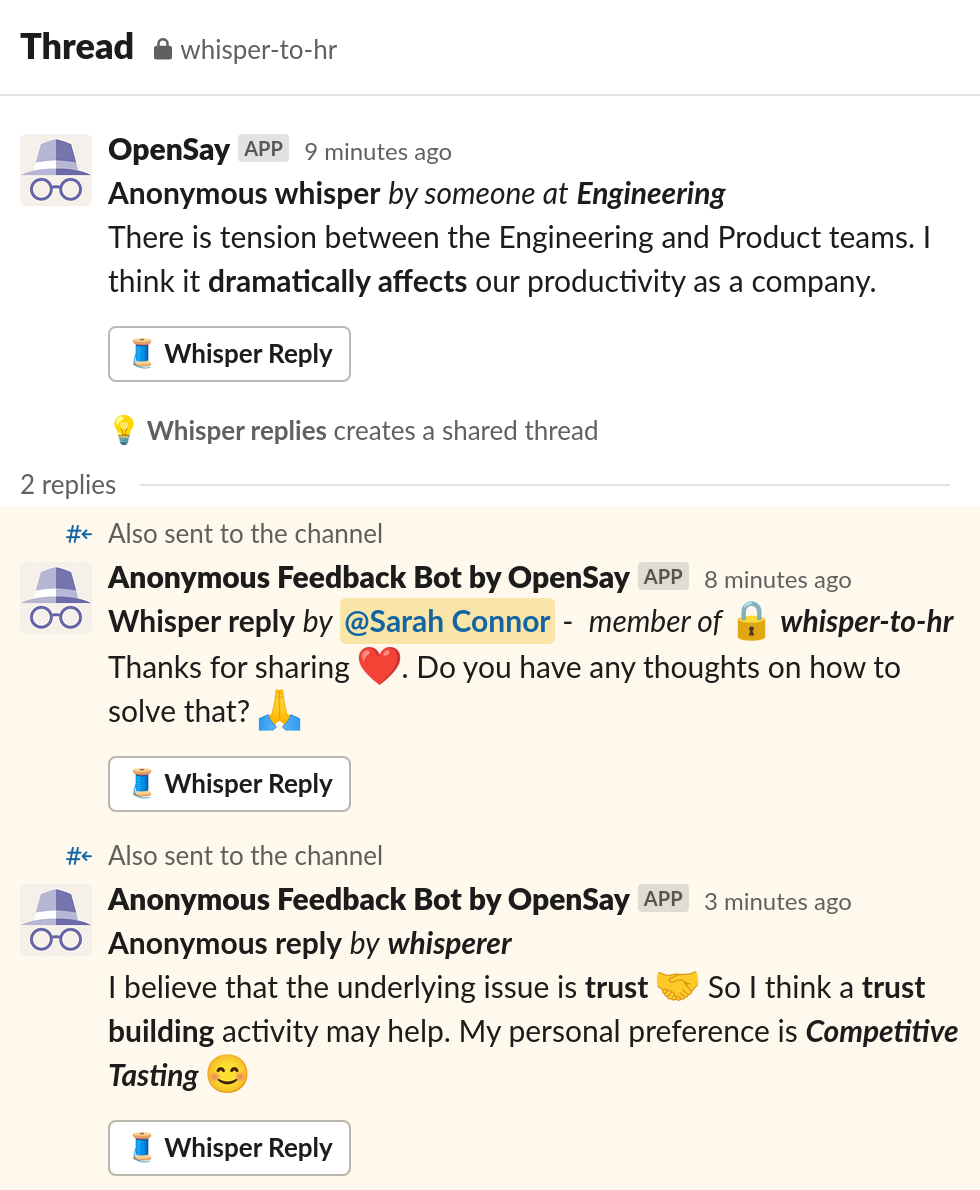
Three weeks after launch, a backend developer noticed an unhandled token revocation bug in their payment microservice. Rather than staying silent or submitting into a black-hole web form, the developer typed `/whisper` directly in Slack, chose `#whisper-to-cto`, selected **Anonymous**, and typed their message.
Here is what happened next:
- Instant, Private Dispatch: The whisper arrived immediately inside the restricted
#whisper-to-ctoSlack channel. - Executive Reply: The CTO opened the thread directly in Slack and replied: "Thank you for flagging this. Can you point me to the service endpoint or the PR branch so I can inspect the logic without raising alarms?"
- Encrypted DM Bridge: OpenSay forwarded the CTO's response into a private, encrypted direct message with the anonymous engineer.
- Anonymous Reply: The engineer replied within their DM: "It's in
services/billing-authon PR #412, lines 84-112. The token refresh doesn't check redis lock expiry." - Swift Resolution: The CTO quietly reviewed the PR, left an architectural comment, and the bug was fixed before touching production.
The entire exchange took less than twenty minutes. The engineer's identity was never exposed, psychological safety was preserved, and a critical production incident was averted.
Today, Whispers is one of OpenSay's most actively used features across thousands of organizations.
4. Why Two-Way Communication in Slack Is a Technological Milestone
The shift from static web forms to native Slack whispers represents a fundamental upgrade in how organizations operate.
Zero Context Switching
Employees already spend 6 to 8 hours a day inside Slack. Asking someone to open an external web portal, remember a third-party login, or navigate a clunky web form creates friction.Moreover, employees worry that opening external whistleblowing or feedback sites on company-managed laptops leaves a trail in network proxy logs and browser histories. By operating natively within Slack through OpenSay's encrypted bot interface, employees can communicate without leaving their daily workspace.
Real-Time, Bidirectional Threads
Traditional suggestion boxes operate on a broadcast model: one party speaks, the other listens. OpenSay transforms anonymous feedback into an active conversation.- Clarification: Leadership can ask for screenshots, code snippets, policy references, or dates.
- Support: Leadership can reassure the submitter that their concern is being taken seriously.
- Case Closure: Once an issue is fixed, leadership can update the thread, letting the employee know their voice had a concrete impact. This closes the psychological loop and builds lasting organizational trust.
Optional Identity Revelation
Trust is built incrementally. With OpenSay Whispers, the submitter has full control over their identity. They can start a conversation 100% anonymously. If the conversation progresses and they feel comfortable doing so, they can voluntarily reveal their identity with a single click—or remain completely confidential throughout the entire lifecycle of the discussion.5. The Regulatory Imperative: Whistleblower Mandates Demand Two-Way Confidentiality
A direct anonymous line to executive leadership is not just an operational advantage—it is increasingly mandated by international law.
Over the past few years, global regulatory frameworks have enacted strict requirements governing how companies collect and handle sensitive employee reports.
1. EU Whistleblower Protection Directive (Directive 2019/1937)
Under the EU Whistleblower Directive (and national transpositions such as Germany's *Hinweisgeberschutzgesetz* / HinSchG and France's *Loi Waserman*), all companies with **50 or more employees** operating in the European Union must implement secure internal reporting channels that guarantee whistleblower confidentiality.Crucially, the directive contains strict procedural timelines that static Google Forms cannot satisfy:
- Mandatory Acknowledgment: Employers must acknowledge receipt of a report to the submitter within 7 days.
- Diligent Follow-Up & Feedback: Employers must investigate and provide substantive feedback to the reporting person within 3 months.
If your reporting channel is a one-way Google Form where the submitter is completely untraceable and unreachable, you cannot legally satisfy these feedback obligations. OpenSay's two-way threaded architecture allows designated compliance reviewers to acknowledge receipt, provide statutory timeline updates, and request supporting evidence—all while maintaining complete cryptographic confidentiality.
2. US Sarbanes-Oxley Act (SOX Section 301)
For publicly traded companies and their subsidiaries, SOX § 301 requires audit committees to establish formal mechanisms for the *"confidential, anonymous submission by employees of concerns regarding questionable accounting or auditing matters."*Whisper channels routed to internal audit and legal teams deliver an audit-ready, secure Slack interface that fulfills SOX mandates without forcing teams onto expensive legacy enterprise portals.
3. ISO 37002 Whistleblowing Management Systems
The international standard for whistleblowing management (ISO 37002) outlines three core pillars: trust, impartiality, and protection. ISO guidelines emphasize that reporting systems must facilitate two-way communication to enable competent investigation while safeguarding whistleblowers against retaliation.4. Cryptographic Anonymity & Data Minimization
Under GDPR Article 5(1)(c), organizations must practice strict data minimization. OpenSay is engineered with security-first architecture: - Message bodies are never stored in external databases. - Submitter IDs are protected using one-way cryptographic hashing. - Reviewers in the whisper channel only see the message content and thread responses, ensuring zero forensic leakage of the employee's personal identifiers.6. How to Set Up an Executive Whisper Line in Slack (Under 2 Minutes)
Setting up a direct anonymous line to your CEO, CTO, or HR leadership takes just a few steps:
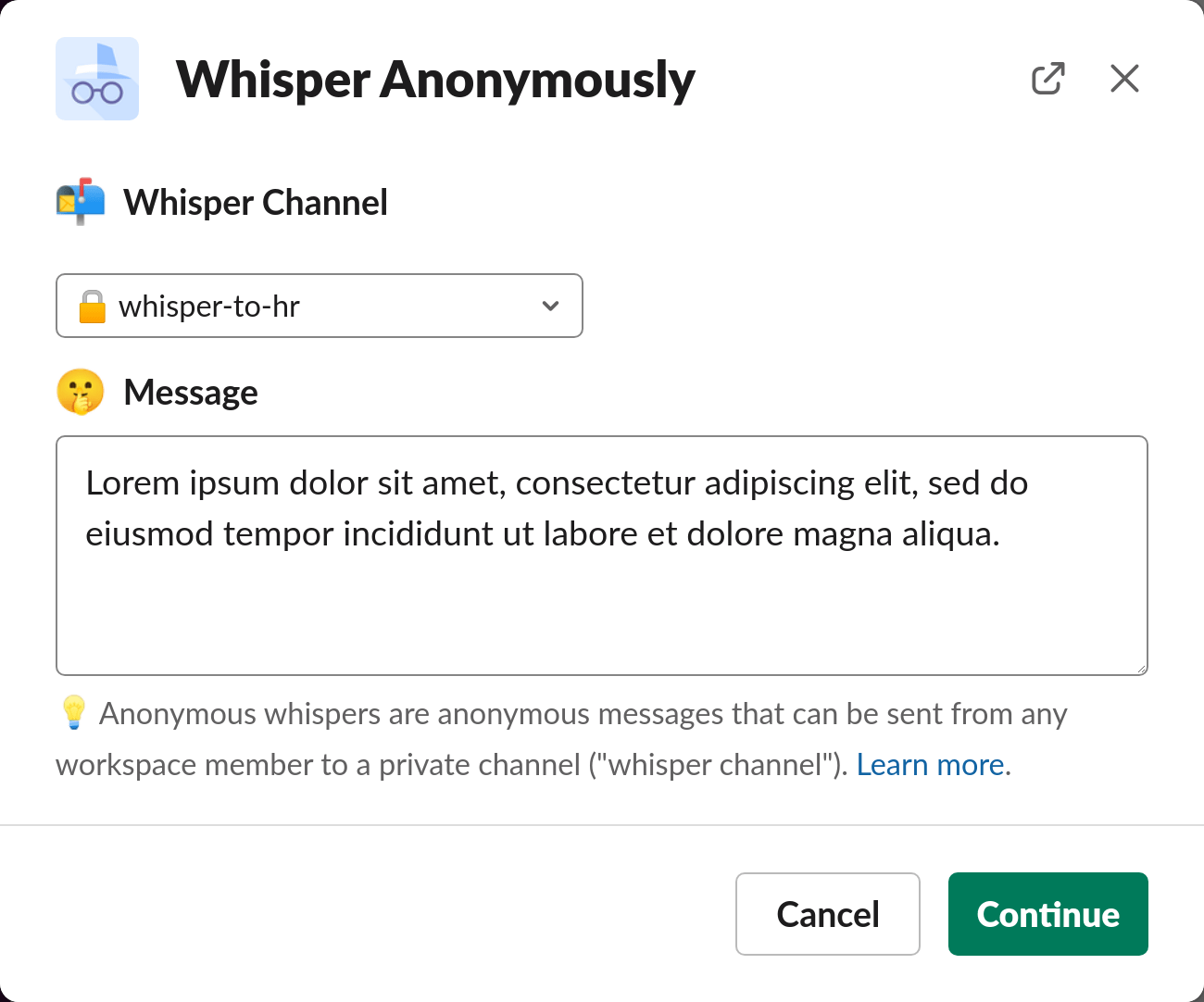
- Create a Private Slack Channel:
Create a restricted Slack channel, such as
#whisper-to-ceo,#whisper-to-cto, or#whisper-to-leadership. Invite only the individuals authorized to triage these communications. - Add OpenSay:
Invite
@OpenSayto the private channel by typing/invite @OpenSay. - Enable the Channel in OpenSay Dashboard: Sign in to the OpenSay Dashboard, navigate to Whisper Channels, and enable your newly created private channel.
- Communicate the Channel to Your Team:
Let your organization know that whenever they need to share sensitive feedback, report an ethical issue, or flag an urgent technical problem, they can simply type
/whisperor/anon whisperanywhere in Slack. - Triage and Reply in Thread: When a whisper arrives, reply directly in the Slack thread. OpenSay automatically handles the two-way relay to the submitter's private direct messages.
7. Comparison: Google Forms vs. OpenSay Whispers
| Feature | Google Forms / Web Surveys | OpenSay Slack Whispers |
|---|---|---|
| Location & Friction | External web link; requires context switching | Native to Slack; accessible via /whisper anywhere |
| Communication Flow | Strictly one-way (dead end) | Interactive, two-way threaded conversation |
| Investigative Follow-Up | Impossible without breaking anonymity | Clarify details, request PRs, and ask questions anonymously |
| Employee Experience | "Black hole" feeling; zero confirmation of action | Real-time DM updates when leadership replies |
| Statutory Compliance | Fails EU Directive 7-day & 3-month feedback rules | Fully compliant with EU Directive 2019/1937, SOX § 301, ISO 37002 |
| Security & Privacy | Stored in unencrypted sheets or web forms | Cryptographic one-way hashing & zero database log retention |
| Adoption & Usage | Abandoned after initial launch | High continuous engagement where employees already work |
Conclusion: Don't Let Crucial Truths Stay Hidden
The most valuable insights in your company are often the ones people are most hesitant to share.
Relying on an "open-door policy" ignores the reality of organizational power dynamics. And relying on an anonymous Google Form leaves leadership paralyzed with vague clues that can never be investigated or verified.
A direct anonymous line to your CEO and CTO via OpenSay Whispers gives your team the psychological safety to speak up, gives leadership the two-way tools to act, and ensures your company meets the highest international compliance standards.
Ready to build a culture of candid insights and unfiltered perspectives? Add OpenSay to Slack today or schedule a personalized walkthrough to see Whispers in action.